





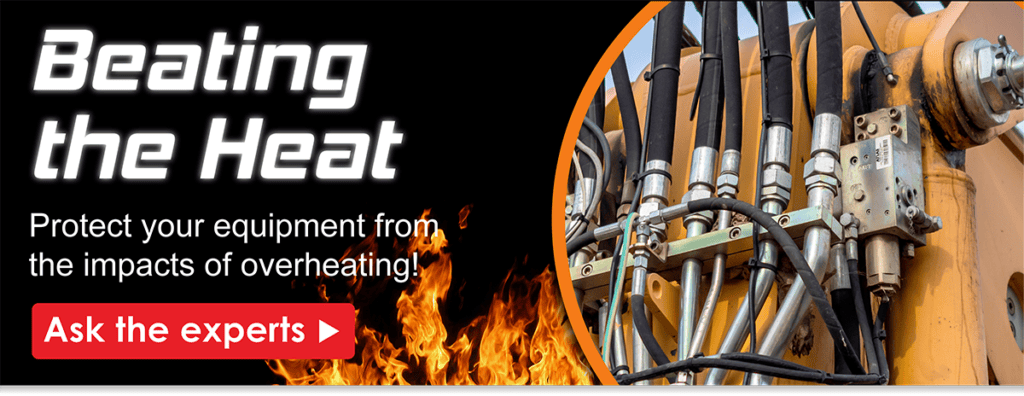
Effects of Overheating on Hydraulic & Lubricating Systems
Hydraulic system overheating can become a serious concern as rising temperatures and demanding operating conditions place additional stress on equipment.
Excessive heat can negatively affect hydraulic and lubricating systems, increasing the risk of equipment damage and potentially catastrophic failure. Two primary consequences of overheating are reduced oil viscosity and accelerated oil degradation, both of which can impact system performance and reliability.
Reduced Oil Viscosity
- Higher operating temperatures reduce oil viscosity, limiting the lubricant’s ability to effectively protect moving components.
- In systems such as gearboxes, inadequate lubrication can allow components to make direct contact, dramatically increasing wear. As components wear, solid debris can enter the fluid and contribute to additional damage throughout the system.
- Combined with hydraulic oil degradation, this increased wear can lead to expensive repairs, unplanned downtime, reduced system reliability, and potentially catastrophic equipment failure.

High operating temperatures accelerate hydraulic oil degradation by increasing oxidation and breaking down critical oil additives.
Hydraulic system overheating can lead to costly repairs, unplanned downtime, and lost productivity.
Schroeder Industries offers specialized filtration and hydraulic system cooling solutions designed to manage excessive heat while removing harmful solid particulates and contaminants from the fluid. By combining effective filtration with hydraulic oil cooling, these solutions help protect critical components, maintain fluid performance, and improve equipment reliability.
Cooling Solutions from Schroeder Industries

Filter Tank Cooling Unit
7-Gallon Tank Volume
Designed for mobile applications, the Filter Tank Cooling Unit (FTC) combines a 7-gallon optimized TNK reservoir, advanced de-aerating filtration, and integrated cooling in one compact system.
By combining filtration and hydraulic oil cooling, the FTC helps manage fluid temperature while supporting clean, reliable system operation. Its space-saving design makes it an efficient hydraulic cooling solution for mobile equipment where installation space is limited.

Gearbox Cooling Skid
3, 6, 10, & 20 GPM
The Gearbox Cooling Skid is specially designed to protect gearbox systems from overheating and solid contamination, with an integrated cooling unit and dual-stage filtration. Air-cooling and water-cooling options are available.
Improve Cooling Through Tank Optimization
Did you know that the hydraulic tank plays a big role in cooling?
In an optimal reservoir design, fluid circulates slowly through the reservoir, allowing air and heat to escape the fluid before it re-enters the system.
However, not all reservoirs are appropriately designed to allow this deaeration and cooling process.
Through a technical Tank Optimization analysis, Schroeder’s experts can examine the flow pattern, temperature, and other aspects of your reservoir to determine if the design can be optimized. Based on their findings, they can modify the tank design to function more efficiently.
Find out how you can improve the cooling and deaeration effects of your reservoir with a Tank Optimization analysis!

Varnish Removal Solutions from Schroeder Industries
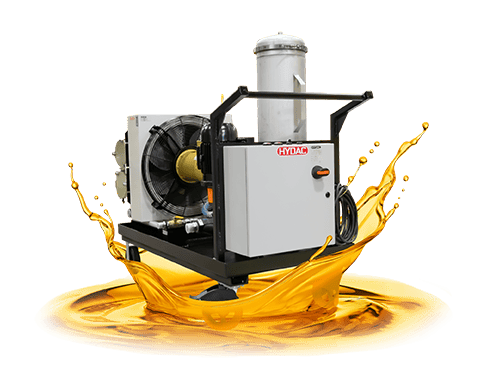
VEU – Varnish Elimination Unit
10 gpm (38 L/min) or 15 gpm (57 L/min)
Available through rental or purchase, this mobile unit is engineered to remove varnish and varnish precursors from mineral oils. An integrated heat exchanger enhances the varnish removal capabilities.

VEU Compact
174 psi (12 bar)
The small footprint of the VEU compact enables installation in applications with limited space. Unlike other varnish-optimized filtration products, this solution effectively removes varnish without integrated cooling.
Detect Varnish Through Bottle Sampling
Varnish and varnish precursors can be detected through sampling, allowing you to proactively protect your system!
However, not all testing services are capable of detecting varnish.
Unlike particulate contamination, varnish can be challenging to identify in a fluid sample due to the submicronic particles, chemical composition, and other factors.
Schroeder Industries can provide the specialized testing required to assess the varnish content in your fluid, providing a foundation for effective fluid monitoring and conditioning.

Ask the experts how you can beat the heat!
Tell us about your application and its challenges, and the experts at Schroeder Industries can help find a solution.
Request for Quote