



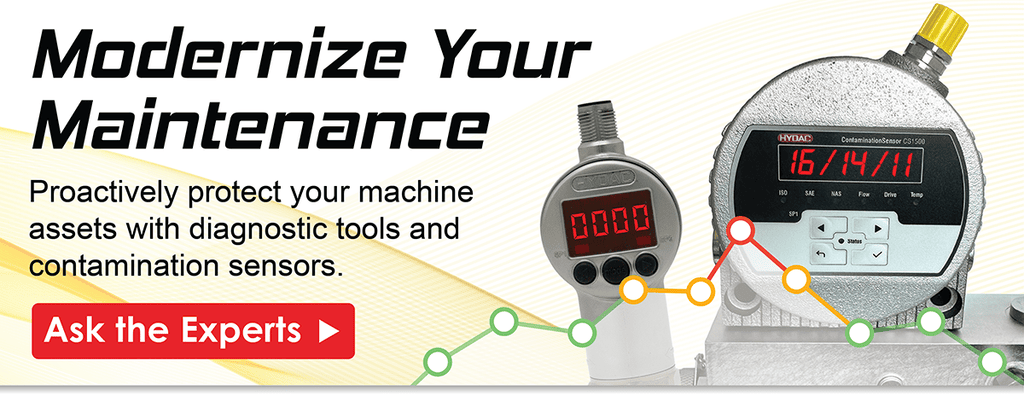
Protect your equipment assets with diagnostic tools and contamination sensors.
As industrial operations expand and become more complicated, real-time fluid condition data becomes increasingly important.
Contamination is responsible for the majority of premature hydraulic equipment damage & failure. Sophisticated sensors and diagnostics tools are critical for ensuring that contamination control targets are maintained.
Schroeder Industries offers a comprehensive line of contamination sensors, saturation sensors, temperature sensors, and other tools that give critical real-time fluid insights. Our experts can provide everything required for an effective predictive maintenance strategy with IoT integration.
What’s the difference between preventative and predictive maintenance?
They sound very similar, but in practice, preventative and predictive maintenance strategies have some key differences.
Preventative maintenance means taking regularly scheduled actions to proactively stop problems before they occur, based on predetermined patterns. For example, you might change the oil in your car after a set number of miles traveled.
This can prevent most lubrication-related engine failures. But, by not testing the oil to see if a change is required, you may be wasting time and money on unnecessarily frequent changes. Or, because you are simply waiting for specific intervals to change oil, you could be missing warning signs of failure in between those intervals!
Predictive maintenance, on the other hand, determines if proactive maintenance actions are needed based on real-time data collected using condition monitoring equipment. Testing your oil to determine if a change is necessary can conserve time and resources, and potentially detect issues early.
Ultimately, predictive maintenance is the smarter maintenance strategy!
Preventative vs. Predictive Maintenance, Differences at a Glance:

Preventative Maintenance

Predictive Maintenance
Contamination sensors and diagnostic tools are critical for effective, predictive maintenance.
Our comprehensive sensor and diagnostic offerings include essentials such as:

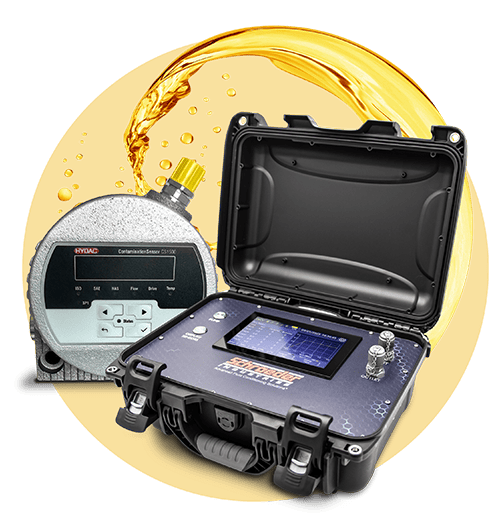
Portable Condition Monitoring Units
Rugged, easy-to-use condition monitoring units that travel wherever fluid analysis is needed!
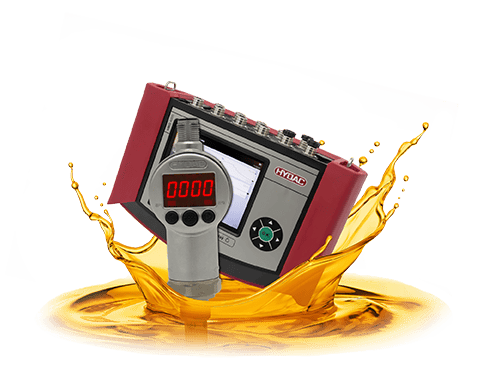
Sensors, Gateways & Data Recording
Schroeder Industries offers a wide variety of sensors and data transfer & recording products!
Condition Monitoring Starter Kits
With so many fluid parameters to track, building a condition monitoring arsenal can get complicated.
Condition Monitoring Starter Kits make it simple! Each kit contains a curated selection of sensors and components.
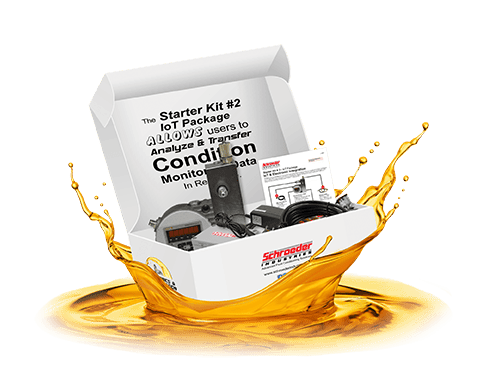
We have the diagnostic tools & contamination sensors needed to modernize your contamination control strategy.
With decades of proven experience in filtration and fluid care, our experts have the knowledge and solutions to help you protect your assets.
Tell us about your application:
Request for Quote
What type of particle counter should I use?
The most effective type of particle counter depends on your application and budget.
There are a few basic characteristics that distinguish particle counters from each other:
Let’s weight the pros and cons of different types of particle counters.
Light-Based Contamination Sensors vs. Digital Contamination Sensors
Particle counters rely on either light-based or digital imaging technology to detect and measure particles, and give ISO Code readings. Each type has its own benefits and drawbacks:

Light-Based Sensors:
Light-based contamination sensors count particles by spotlighting fluid as it flows past a photodiode. The size and quantity of shadows cast on the photodiode are used to determine the size and quantity of solid contaminants.
These sensors are effective on a wide variety of stationary and mobile machines. They are easy to calibrate and maintain, and are considered the more affordable option.
However, air bubbles or water droplets can be interpreted by light-based contamination sensors as solid particles. This phenomenon is called ‘phantom particle counting,’ and can skew ISO Code results.

Digital Sensors:
These contamination sensors avoid phantom particle counting by using image recognition software to eliminate bubbles and water droplets from the ISO Code readings.
A digital sensor can provide more accurate ISO Codes, and some sensors can even guess the origin of solid contaminants based on particle size and shape!
However, digital contamination sensors are also a much newer technology. This makes them more expensive than light-based sensors, and they can be more difficult to calibrate and maintain. Applications are currently limited mainly to portable contamination tools.
In-Line Contamination Sensors vs. Portable Contamination Sensors
Particle counters may be dedicated to a single piece of equipment, or available in a travel-ready unit:

In-Line Sensors:
These sensors are installed directly onto pieces of equipment and monitor that specific machine. They can be easily customized and combined with other types of sensors and accessories.
For plants with fewer, larger machines, a dedicated in-line sensor is a great way to monitor individual machines as they operate!

Portable Sensors:
Portable particle counters are stand-alone units which include their own built-in pump, allowing them to travel between machines.
A portable contamination monitor can travel wherever fluid condition monitoring is needed and easily perform checkups on multiple machines and vehicle fleets!
Contamination Sensor Connectivity
The best data in the world isn’t much use if it can’t be exported, compiled, and reviewed! This is where IoT, the ‘Internet of Things,’ becomes important for making use of the information gained through the sensors.
What is Internet of Things (IoT)?
The Internet of Things (IoT), can be compared to “the cloud” that many people use on their phones. For fluid conditioning purposes, IoT is a network that works within fluid sensors and condition monitoring software. This allows contamination readings to be recorded and remotely accessed by operators.
Digital connectivity is essential for contamination sensors. Every effective contamination control plan requires accurate data to not only demonstrate that contamination control measures are working, but that sudden spikes in contamination are quickly detected and resolved.
Contamination monitors typically have some method of transferring data, be it through Bluetooth wireless connectivity, thumb drives, spreadsheet files, SCADA/PLC interfacing, and more. Integration with web and smartphone-based applications is increasingly common as well.
Whatever the size or complexity of your operation, be sure to choose sensors that can effectively log and transfer your fluid contamination data!
