




The 4 Definitive Qualities of a Good Filter Element
Comments Off on The 4 Definitive Qualities of a Good Filter Element
What Makes a Good Filter Element?
Selecting the right hydraulic filter element is one of the most important decisions for maintaining fluid cleanliness, protecting equipment, and maximizing system performance.
Filter elements are at the heart of every hydraulic system. While elements are often treated as a disposable afterthought, their contamination-busting role makes elements absolutely critical for system longevity and performance.
So, if you’re thinking of trying to cut costs with cheap, generic filter elements—think again.
Quality truly matters when it comes to filtration. Whatever you might be saving in element costs, you’ll likely end up losing more in maintenance and repair costs, productivity impacts, and more frequent element replacements.
If using quality filter elements is so important, what should you look for in an element?
There are essentially 4 key metrics by which you can judge the effectiveness of a filter element:
Let’s get in to what each of these metrics mean for element performance, and for the integrity of your equipment and fluid assets.
High Beta Efficiency
Filter elements come in a range of different micron ratings—that is, the size of particle the filter is rated to capture.
But, just because a filter has a certain micron rating, that doesn’t necessarily mean that it efficiently captures particles of that size!
Let’s look at an example of two elements tackling solid particles 5 microns and higher:

The percentage of particles of a given size that a filter captures is known as its beta efficiency.
Certain elements may be nominally rated for a certain micron rating, but actually have a relatively low beta efficiency. For example, a cellulose media element rated for 5 microns could have a beta efficiency as low as 50%!
When you choose an element, be sure to choose elements with a high beta efficiency to ensure the elements are actually capturing the contamination you are targeting.
Minimal Pressure Drop
In a hydraulic system, maintaining consistency in system pressure is key to efficient system performance.
However, filter elements by their nature are somewhat disruptive to pressure in the system. In order to filter out contaminants, elements inherently have to interrupt the flow of fluid to some degree!

Particle capture/filtration and maintaining system pressure must be carefully balanced.
While removing as much contamination as possible in hydraulic fluid is ideal, the tighter the filtration tolerance of an element (i.e. the smaller its filtration rating), the greater the impact on pressure downstream of the filter.
A high-quality filter element is engineered to balance effective particle capture and system pressure, protecting the machine with minimal impact on its efficiency.
Sometimes, operators may sacrifice filtration performance to ensure that they minimize the pressure drop in their system. In reality, a high-quality element can provide effective filtration without excessively affecting system pressure.
Schroeder Case Study: Minimal Pressure Drop Elements In Action
End users operating frac trailers were deliberately avoiding higher-performance, lower micron-rated elements due to concerns about pressure drop.
But, with the right element, exceptional particle capture with minimal hydraulic system pressure drop is possible!
Schroeder Industries replaced the customer’s existing 40 micron elements with a new 25 micron solution. The 25 micron elements offered similar pressure drop characteristics as the original 40 micron elements, but provided significant improvements in filtration performance.
Here’s how Schroeder’s superior elements helped this customer:

40% Increase in Particulate Removal Efficiency ≥25µm

36% Increase in Element Dirt Holding Capacity

Element Change-Outs & Maintenance Downtime Reduced
High Dirt Holding Capacity (DHC)
Given the role of the filter element in trapping contamination, the amount of solid particulates the element can hold—commonly called ‘dirt holding capacity,’ or ‘DHC’—is another major factor in element quality.
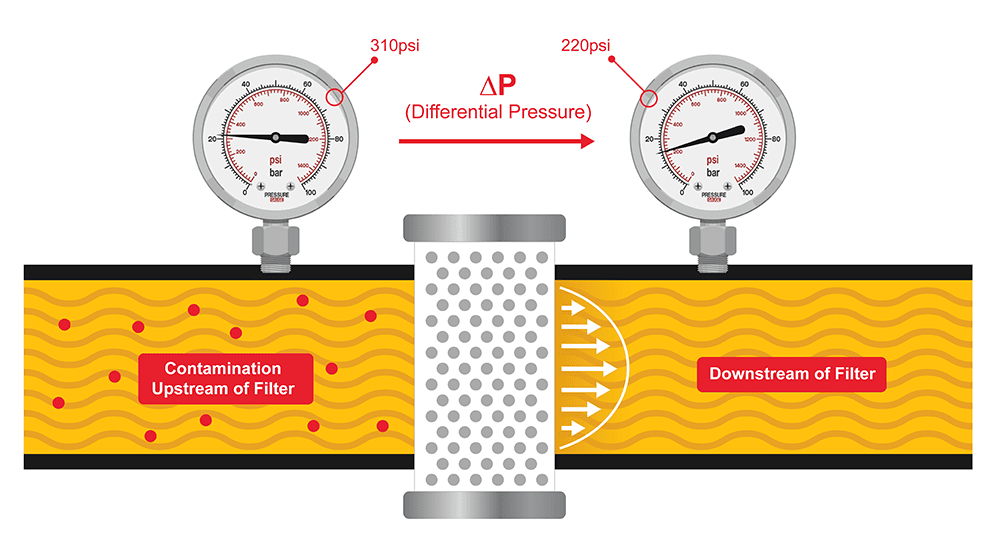
But, the more particles an element captures, the greater the effect on system pressure.
When the element has accumulated enough particles that it causes too much pressure drop downstream of the element, it has reached its DHC and must be changed out for a fresh filter element.
Note how the downstream pressure drop changes from when the element is new to when DHC is reached:
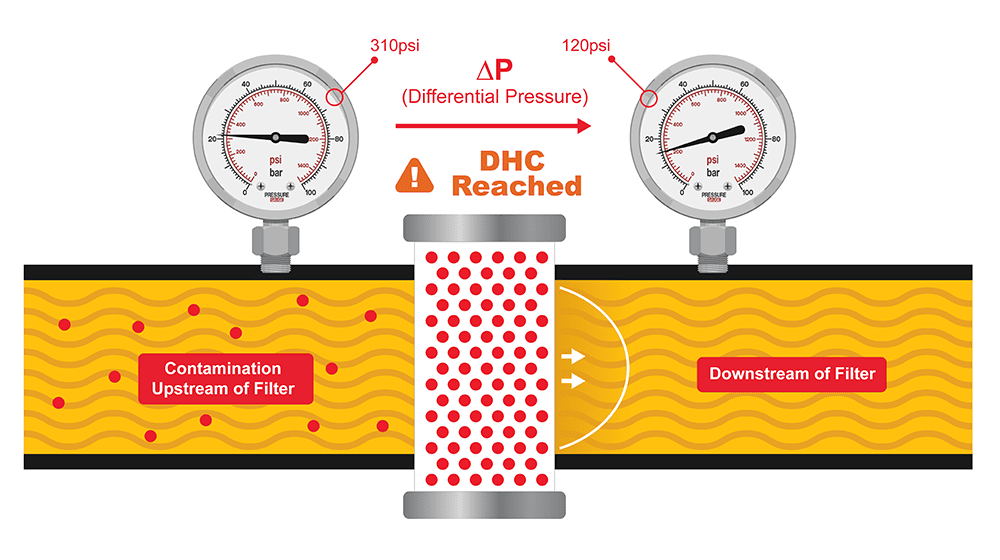
The more contamination a filter element can capture without causing too much pressure drop, the longer the filter can go without maintenance. That’s the key to good DHC!
This not only reduces the costs associated with purchasing new replacement elements, but reduces maintenance-related downtime.
Beta Stability
This aspect of the filter element is closely related to its DHC and efficiency.
Basically, beta stability is the determination of how efficiently the element captures particulates as it approaches its DHC.
For example, if an element rated for 5 microns begins struggling to capture 5 micron particles as it approaches its DHC, that element has poor beta stability.
If an element is rated for 5 microns, it should be capturing 5 micron particles whether the element is at 1% DHC or 99% DHC!

Final Thoughts: Choosing the Best Element
When it comes to selecting the best filter element, the key is a balance between all four of the key traits described above.
An element may have high beta efficiency, meaning it excels at capturing particles of a certain size…but if it loses that ability as it approaches DHC, then it has poor beta stability. If it has a low DHC, then you will need to interrupt operations and purchase replacement elements more often. And so on!
The right filter element finds a balance between all of the above principles, giving you excellent filtration without compromising system efficiency and with minimal maintenance needs.

Want to upgrade your filter elements? Try the BestFit Cross Reference Search Tool!